Performance wingsuiting pushes pilots to their limits of how fast they can fly horizontally, how far they can fly and how long they can fly for between a set altitude. The idea being that it measures least drag, highest glide and most lift. This is a solo competition where the data is recorded by a small computer such as a FlySight which is handed to the judges for scoring once on the ground. Each round of the competition is made up of 3 jumps doing a different task per jump and generally there are 3 rounds. This means across the 9 jumps, the pilots will have 3 attempts at each task. In order for a completed competition 1 full round must be completed (i.e 1x speed run, 1x distance run and 1x time run).
Tasks
The order of the tasks will be drawn from a hat at the competitors briefing prior to the start of the competition. This order will then loop 3 times to make 3 full rounds.
The competition window is from 2500m to 1500m. Nothing outside of this window is scored, although penalties can apply until opening .
Speed
For the speed task, the highest average horizontal speed over ground achieved while in the evaluation window counts; the further you fly in the shortest time while in the competition window, the better
Time
For the time task, the time spent in the evaluation window counts; the longer you stay in the competition window, the better.
Distance
For the distance task, the horizontal distance covered over ground while in the evaluation window counts; the further you fly while in the competition window, the better.
Each individual task has a medal so even if you have a preferred task that you focus on, you may still take a medal home! This means the competition does not favour different body shapes and weights as a heavier person which may naturally score higher on speed would naturally not be as strong in the time task.
Scoring
The scoring is calculated as percentage. The pilot who comes first scores 100 and then each competitor scores the percentage of what their performance is compared to that.
Let’s say we have two competitors “Pilot A” and “Pilot B”. Pilot A flies an average speed of 250km/h and Pilot B an average speed of 200km/h through the window. This means that the scores for that round will be Pilot A with 100 and Pilot B will score 80 because 200 is 80% of 250.
It may be beneficial to explore the competitions hosted on SkyDerby to understand the scoring (plus it will also give insight into your competition!). An example is the 2025 Australian National Championships: https://skyderby.ru/events/performance/577.
Personal Locator Device
A PLD is an essential part of competition as it records your performance.
You will be provided a PLD by the judges at the start of the competition. This PLD is managed by the judges and you are not allowed to interfere with it whatsoever. Once it is attached to your helmet at the start of the competition, your helmet will be taken into custody of the judges to ensure the security of the device. Before your load, your helmet will be provided to you and the PLD will be turned on by the judges. They are responsible for ensuring they are sufficiently charged, turning it on and off as well as checking it has signal before boarding and the configuration of the device. Any issues with the competition PLD are the responsibility of the judges and should be taken up with them.
Because your helmet will be taken into custody and there may be a delay in your score, you might want to bring your own PLD which can be removed from your helmet so you can review your own performance and configure it as necessary for the next task.
Most competitors use FlySight as a PLD.
FlySight
Your personal FlySight can be configured to give you audible feedback on your performance as well as window indicators so you know when you are being scored. This can be verbal or simple beeps. The reason for using beeps is that it more instantaneous than a voice. Think about how long it takes to say “one point seven”. Your glide may have changed between the start and end of the sentence when travelling as 250km/h. This is why beeps which differ in pitch and frequency are beneficial. Voice is far easier to understand, configure and understand in a high stress environment so it would be advisable to start with this and then progress to beeps further in your performance flying career.
Read more at the FlySight website at https://flysight.ca/ and on their wiki at https://flysight.ca/wiki/index.php?title=Main_Page which includes information on how to configure it.
Lanes
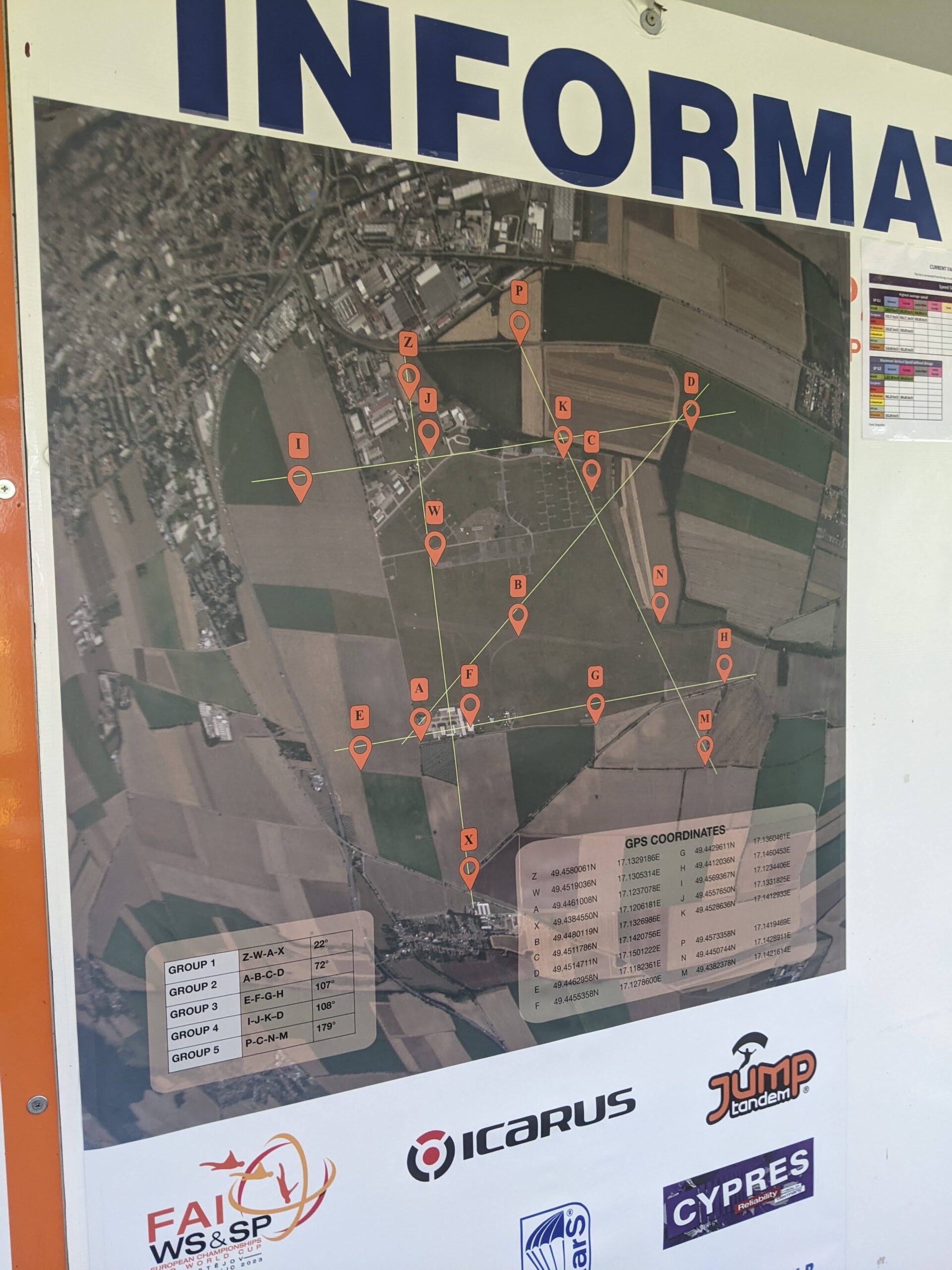
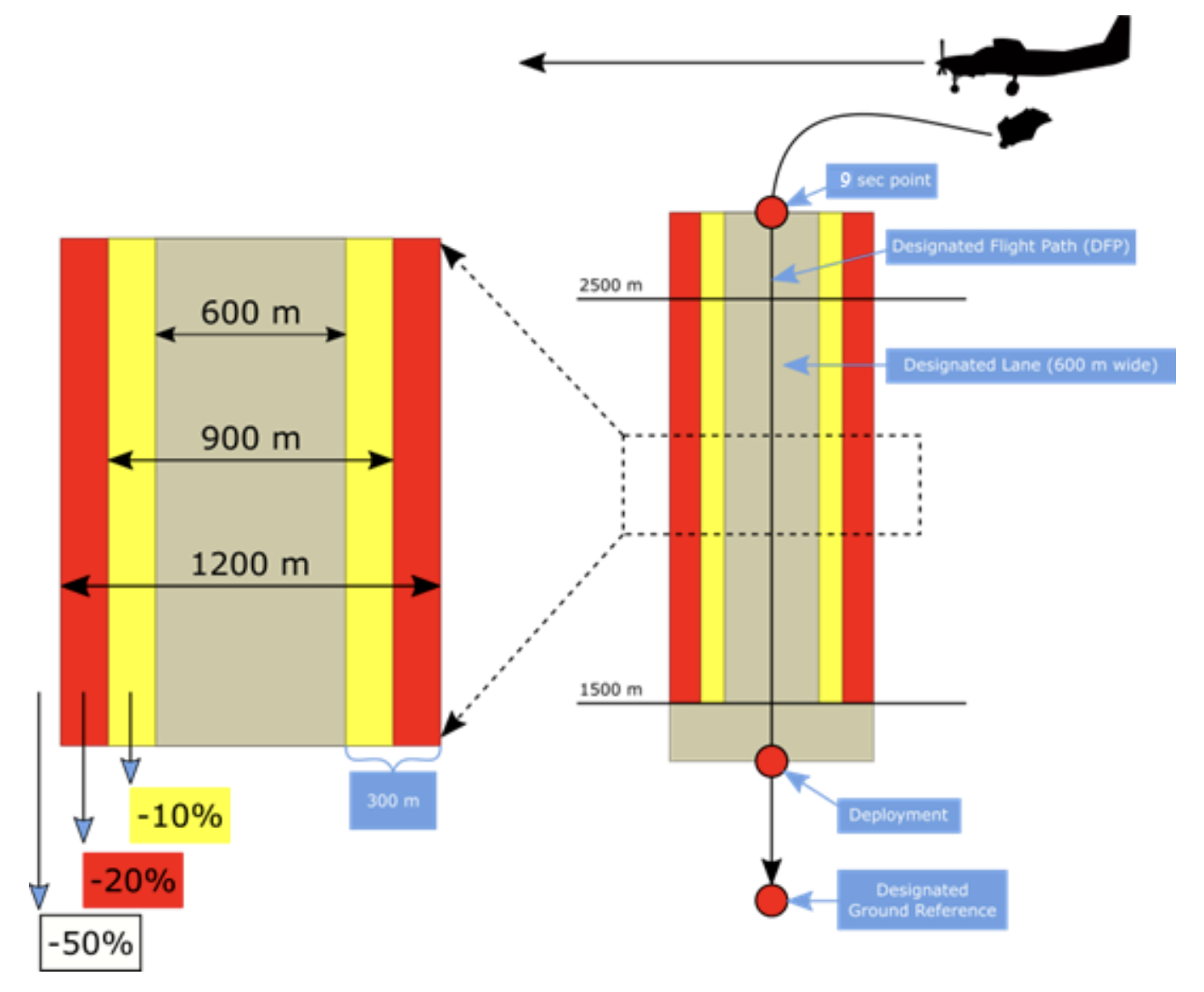
Flying a wingsuit as fast as you can would be extremely dangerous without knowing the airspace is clear. Having allocated lanes keeps distance between competitors. The lanes are 600m wide. It is important to stick to your lane for safety but also because drifting out will result in a penalty to your score.
Your lane will be allocated to you by way of a point on the ground being assigned. This assignment will be done with enough time to study the line of flight before boarding and are rotated between jumps. When exiting the plane, this will be the target. The official lane begins 9 seconds after the competitor’s vertical speed first reaches 10m/s and ends 66ft (20m) below the competition window. A straight line from the point at 9 seconds to the point on the ground to designate the lane.
The run-in will not fly over the drop zone like a normal run-in. The aircraft will fly offset from the drop zone parallel to the points a few miles away. This means the points will be visible out the door perpendicular to the run-in and a 90 degree turn will be required to get on heading. Ideally, the run-in should fly cross-wind so that when you fly to your point, there is a tail wind for an extra boost!
Penalties
There are 4 levels of penalties for lane violations; 10%, 20%, 50% and 100%.
| 10% | Less than 150m outside the lane. |
| 20% | 150m-300m outside the lane. |
| 50% | 1st infringement of more than 300m outside the lane. |
| 100% | – Subsequent infringements of more than 300m outside the lane. – Coming within 150m of any other competitor before deploying your parachute subject to panel of judges. |
Head Up Displays
In order to keep you aligned in your lane, a HUD may be very beneficial and is used by all top competitors in the sport. This can vary from a simple LED strip indicating drift up to full data streaming such as visual glide indicators. Most of these are designed and built at home by competitors so it is best to talk to people to find out more information about them or get creative and build something yourself. Right now, there is no regulation on HUDs.
Suits
Different suits have different flying characteristics and of course, it would be unfair to put a Havoc Carve against a CR+ so they are broken into categories. These categories apply to British Skydiving rules and may differ in other jurisdictions.
Rookie
The smallest suits available which are appropriate for beginners just getting into wingsuiting. These can still be raced just like the bigger suits and are great for learning the core skills for performance flying. Sometimes they can outperform intermediate suits!
Examples include:
- PF Shadow
- Squirrel Sprint
- Intrudair Piranha
Intermediate
These medium sized suits are a good stepping stone from the beginner suits and great for honing skills before upsizing to more powerful suits.
Intermediate is when the arm wing connects below the hip.
Examples include:
- PF Havoc Carve
- Intrudair Fin
- Squirrel Low-Ki
Advanced
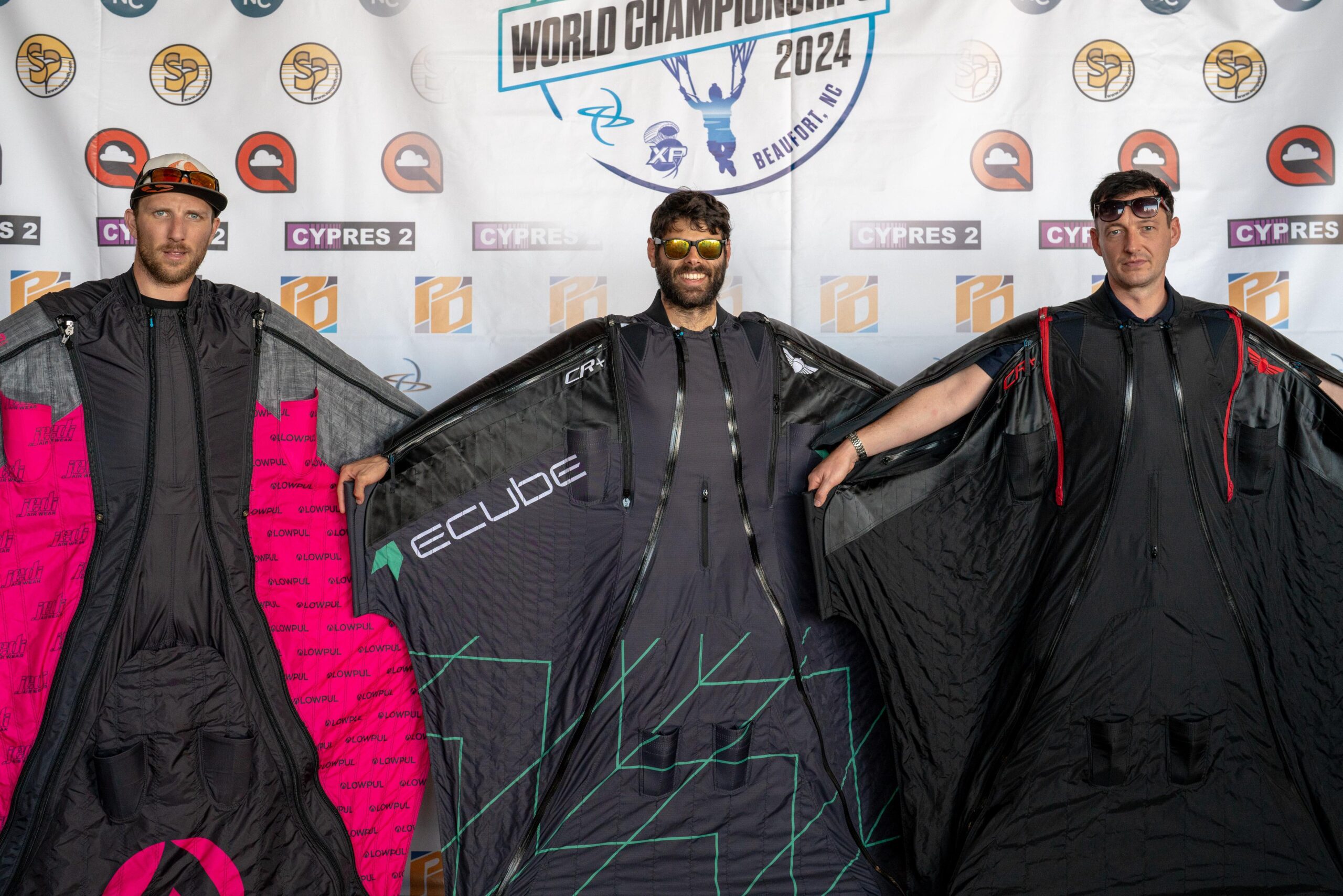
These suits are the biggest available scaling from acrobatic suits up to the highest performance cutting edge race suits. Only this category qualify for the World Cup and Championships.
Examples include:
- Squirrel Freak
- Intrudair Mako
- PF Vampire
- Squirrel CR+
HAVE FUN
Lastly, the most important part of every competition is have fun! We’re all learning, improving and discovering this crazy pursuit of human flight. Come to a competition to meet some awesome people, have some awesome fun and make some awesome memories.
Once all 9 jumps are over, there is usually an opportunity to get on some fun jump loads for some epic flocks. Rarely do so many highly skilled pilots gather in a single place!