

Introduction
For many, a major blocker to getting into wingsuits can be the misunderstanding that their kit is not suitable / dangerous for wingsuiting and changing it is either too expensive or simply not worth doing for a small amount of jumps they may do in a year.
While it is true that we do need to make a few simple considerations, you may be surprised to find that your rig may be closer to being able to use a wingsuit safely than you may think.
In this article I will go over the main considerations and highlight which ones are really required and those you may wish to build into should you continue on your Wingsuit journey with a general aim to provide you with a better understanding of the options available and why some people choose them.
I also want to leave you with a sense that you don’t need to change a huge amount to actually start flying wingsuits and with this article I would like to present all the options and detail which ones you really need and those which can come later if you wish.
Since this article covers aspects of safety, I am obliged to highlight these two points:
- If you have any questions on the actual wingsuits, getting into wingsuiting then talk to your local Dropzone Wingsuit Coach. A great resource for this is here – https://staging.wingsuiting.uk/coaches/
- If you have any questions concerning your rig, its parts etc… then reach out to your local Skydiving instructors and rigger
Ok with that out of the way, lets begin.
General Considerations
As a general rule there are not too many additional considerations when talking about your rig. We strongly recommend that it is freefly friendly, in good overall condition and packed so that bridle, risers and lineset is stored correctly.
While much of our early wingsuit flying will be in a belly to earth position we cannot discard the possibility that we may find ourselves in odd orientations when learning.
In general if you would not free fly your rig (either sit or head down) then you probably should not fly wingsuits with it.
Pilot Chute
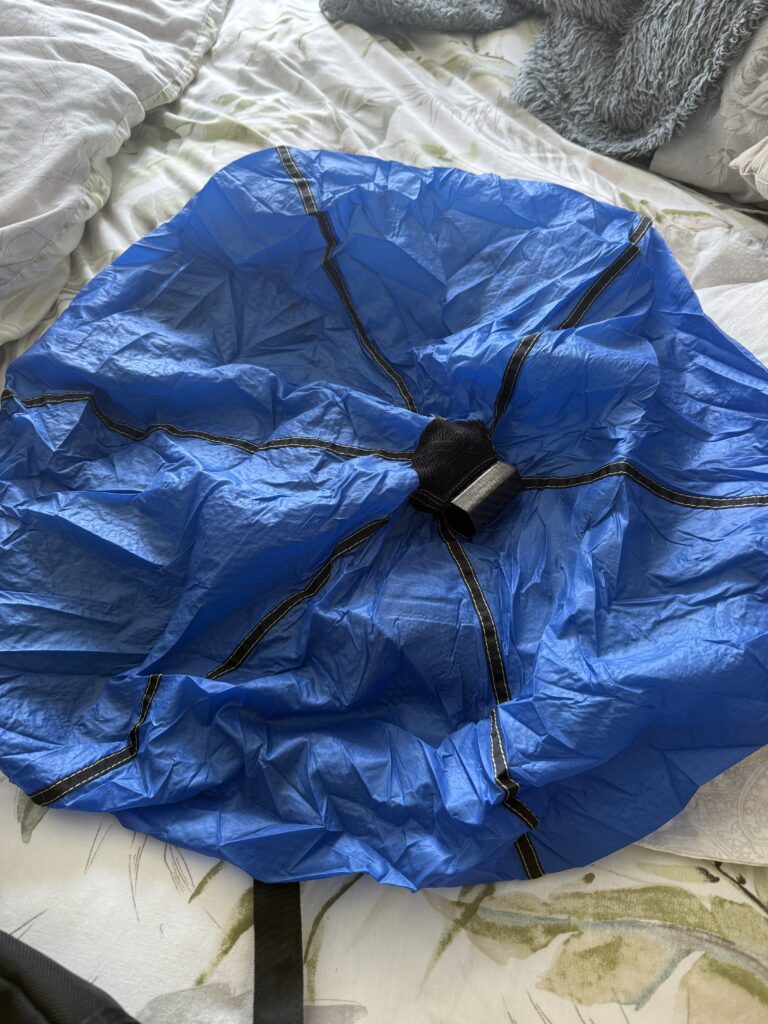
Our pilot chute represents the first contact point with the air during the deployment sequence and is a simple component of your rig. We do need to be mindful of a few basic facts.
As discussed in a later section one of the main features of wingsuiting is the reduction of our vertical (downwards) speed and this results in less air for the pilot chute to grab onto during deployment.
We are in effect always doing a sub terminal deployment.
This means our Pilot chute will be much less effective if:
- The pilot chute is showing extensive signs of ageing (hold it in front of a light source, are there lots of bright patches) meaning it catches less air?
- The kill line for collapsible pilot chute is shrinking and so it is harder to ‘cock’ the pilot chute.
Ok so what is the Squirrel SkySnatch / SkySnatch2 all about? Well firstly, I have one (hypocrite) and these pilot chutes can be used just fine for normal skydiving.
These Pilot chutes are not “more effective” or “better” at extracting your main canopy, all they do is make use of a torus like (donut) shape to ensure the pilot chute is more ‘stable’ when being thrown, this lack of ‘wobbling’ about means they have a cleaner pull on your deployment bag and reduce risks associated with twists etc…
As such for your first set of wingsuit jumps, you just need a pilot chute in good condition, that is it. No special requirements, no specific brand, just a normal pilot chute that works when used.
Bridle
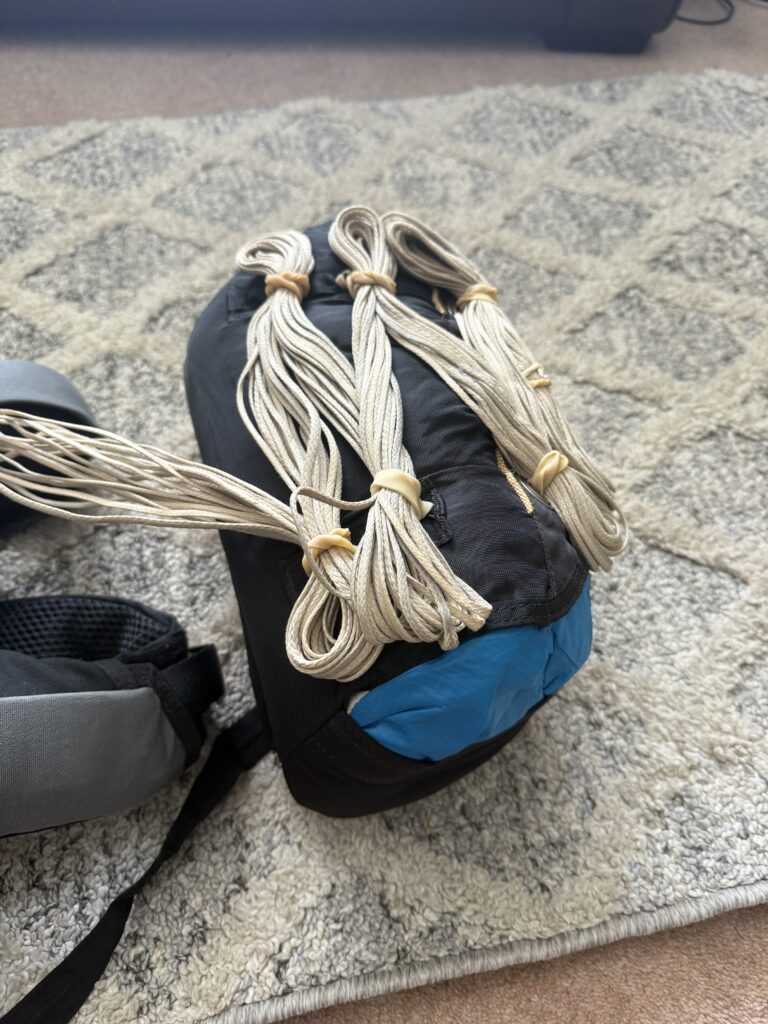
To extend or not extend, that is the question. In general when we fly a wingsuit we are creating 3 burbles which (if we don’t do a good throw) will interact with the pilot chute creating hesitations and possible problems further down the line.
Extending our bridle will mean the pilot chute has a longer travel to line stretch and so can get further away from the burble (and hopefully reducing risk); there is however a trade off.
The longer the bridle the more separation speed is generated between you and the pilot chute which results in a more positive pull (not always a bad thing).
The second consideration is during packing, what to do with all this extra bridle, you may need to change how you pack your pilot chute (especially if you stuff the pilot chute) and the extra length also adds risk of creating a knot in the BOC making for a hard pull (something that has happened to me at 4k).
In general for your first few jumps with small or intermediate suits a standard length bridle is just fine. Your WS coach will teach you a good deployment technique and all you need to make sure is to execute on that and complete a really good (and symmetrical) throw!
If you find yourself going into bigger, faster suits then this is the time to extend your bridle, until then a standard length bridle works just fine.
Deployment Bag
Deployment bags generally come in two styles, the standard and the stowless bags and both are happily supported for wingsuits.
I have a standard deployment bag and I double stow everything when packing. Lots of people have moved over to stowless which uses a BASE style figure of 8 pattern in a pocket to store their lines.
I am told this makes for smoother deployments (with less hang ups which can happen with standard deployment bags) but like the bridle there is a trade off. Using a stowless bag while seemingly simpler does mean you need to ensure the lines are correctly stored. If you have a standard deployment bag, great!. If you have a semi stowless bag, also great!
The Main Canopy
Ok let’s do the big one, the main issue, the elephant in the room!
One of the biggest changes we need to make when moving into Wingsuiting is that of our main canopy.
Many a skygod / AFF / Tandem instructor who wanted to try flying a wingsuit have stopped because their Velocity, Valkyrie or Leia does not represent the stable platform we are looking for at the best of times (let alone when we add a potentially spinning skirt).
As such we have to accept that there are some canopies that are simply unsuitable to fly a wingsuit.
Fun fact – The British Skydiving Wingsuit Coach manual says (page 7) so long as the student is comfortable with the consequences of flying a swoop canopy (and you are) then fine!
So why is this? The wingsuit allows us to fly faster forwards then most people do when tracking and during the deployment sequence (which is usually rushed the first few times) not enough speed is shed before the student deploys. This combined with potentially unorthodox body positions (not fully shutdown wingsuit) will in most cases result in line twists (if not off headings) that need to be resolved.
If you have a canopy that does not react well to such things then you will have to deal with this AND the added complication of dealing with what is potentially now, a flying bodybag.
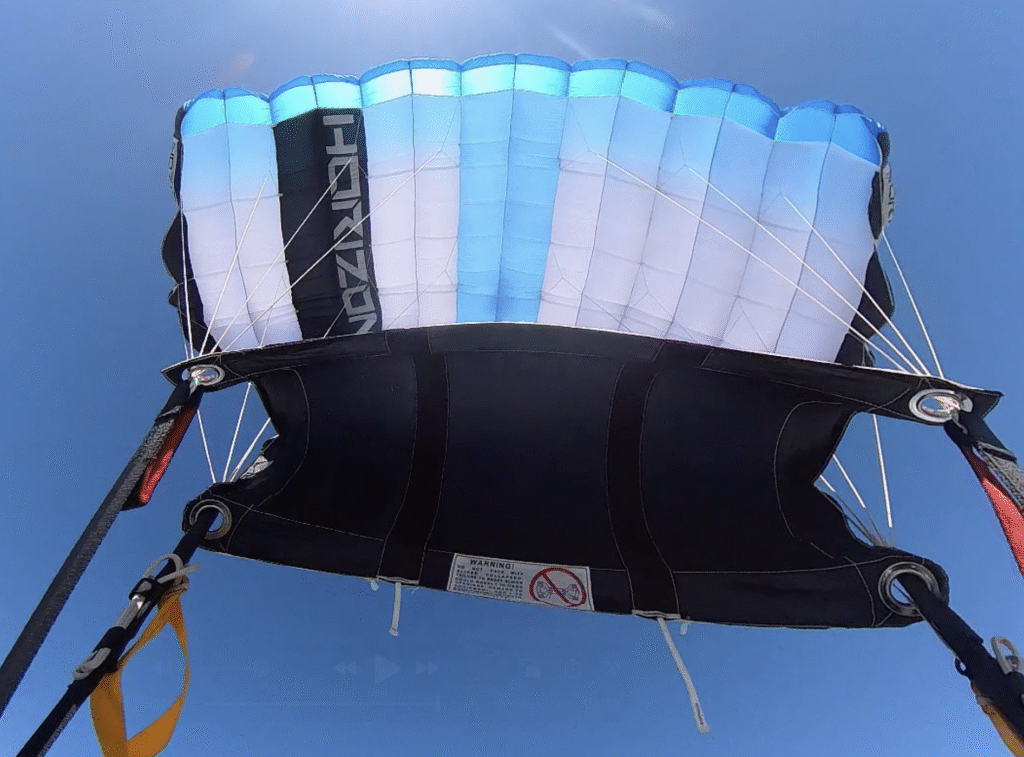
To help with this, and as the wingsuit market share has grown, so have a number of wingsuit specific canopies been introduced, this could be the Horizon by Performance Designs, the Kraken by JYRO, Pilot 7 by Aerodyne, the Epicene by Squirrel or the WinX by Atair.
In general they are all 7 cell canopies, usually have some aspect of Low Pack volume material in their construction and some (like the Horizon) do not recommend regular terminal deployments (as it will shorten its lifespan).
These are all great canopies and come in some pretty sporty sizes (I jump a PD Horizon 135) but in general are totally unnecessary for your first Wingsuit jumps.
So long as your canopy adheres to the below, it should generally be fine for those first few jumps.
- Reacts well to line twists and uneven deployment / inflation
- Keep above the student’s head during line twists to allow them to sort it out
- Generally not to ground hungry or considered a proper swoop canopy
Some of the features that can help here would be:
- A Non elliptical Canopy (so Sabre 2, Pulse, Spectre, Pilot, etc…)
- A wing loading (with kit) that’s no greater than 1.2 (good resource is https://pureskydive.com/canopy-wing-loading-calculator)
- A line set that is in good condition
So long as you follow the above general guidance it’s likely your canopy will be fine for your first set of wingsuit jumps. If / when you decide to progress beyond student or intermediate suits then it is wise to consider a more Wingsuit safe canopy.
AADs
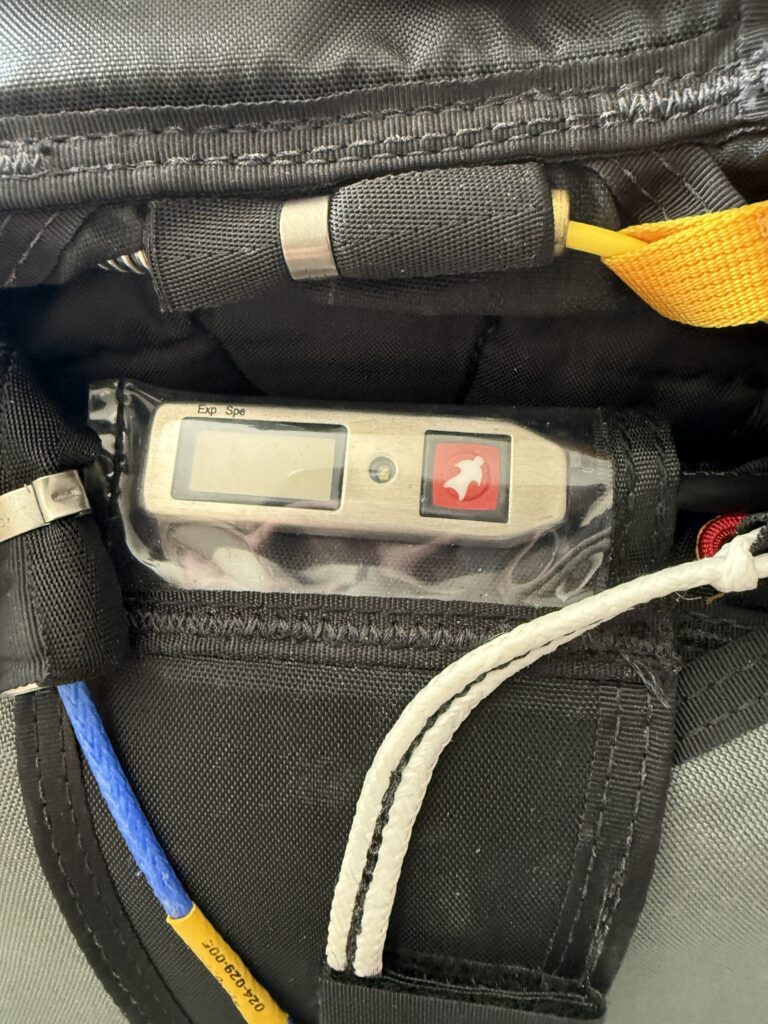
Since the introduction of the modern AAD (I am thinking Cypres, VIGIL etc…) we have seen huge progress in terms of not only AAD performance but also how adaptable they have become with new features such as C-Mode, different flavours of AAD to cater to more specialist parts of our sport (such as the Speed Cypres or Tandem modes) and even experience levels (Student versus Expert).
This increase in performance applies equally to Wingsuits where it is now possible to fly a wingsuit next to a fully inflated canopy (the basis of XRW) and can even beat it in terms of glide ratio; this however, has implications in how we use AADs.
For example, when you are in a wingsuit flying next to a fully inflated canopy – does your AAD think you are under canopy or in freefall?
Adding a wingsuit does not change the fact that we should be using an AAD nor should it change our approach to using one, but we do need to be more mindful.
In general a wingsuit’s main aim is to extend our flying performance by allowing us to fly at faster horizontal (forwards) speeds and much lower vertical (downward) speeds, this in turn gives us more time to play and cover far more distance.
This reduction in our vertical speed is the main consideration for AADs, the bigger the wingsuit the slower our vertical speed can potentially be and the closer we get to making the AAD believe we are actually under canopy.
The questions to ask yourself would be:
- If I am incapacitated in a wingsuit or otherwise unable to pull – will my AAD understand this and intervene given the slower vertical speed? In all likelihood the answer is yes but it’s certainly not as clear cut as perhaps it would be doing a regular slick jump.
- Would the same be true if I am using an AAD with more permissible speeds (such as the Speed Cypres etc…)
While I am not going to offer practical answers to these questions here, the general gist is that since we are adding “go faster stripes” (the wingsuit) to an already “go faster” sport. Because of this we also need to have a better awareness of the implications including an understanding that some of the safety guide rails that we rely on in day-to-day jumping may not be as sturdy as we first thought when adding wingsuits.
- We need to internalise this, accept it and make judgement call.
- We are not new skydivers anymore and the more we understand, the better we can make decisions.
If you have a modern AAD that has been well maintained, not the Speed, Student or Tandem settings then your AAD is absolutely fine for small (like the ones we fly during WS1 and WS2 stickers) to intermediate suits and should provide similar levels of protection you get now.
You do not need to change anything and can happily carry on as you have been.
If you are progressing into the larger more performant suits we need to be mindful that the performance of that suit will be getting incredibly close to what a standard canopy can produce in terms of fall rate and acknowledge the line where an AAD detects a no pull is now starting to get more blurred than it once was.
RSL / Skyhook / MARD Systems
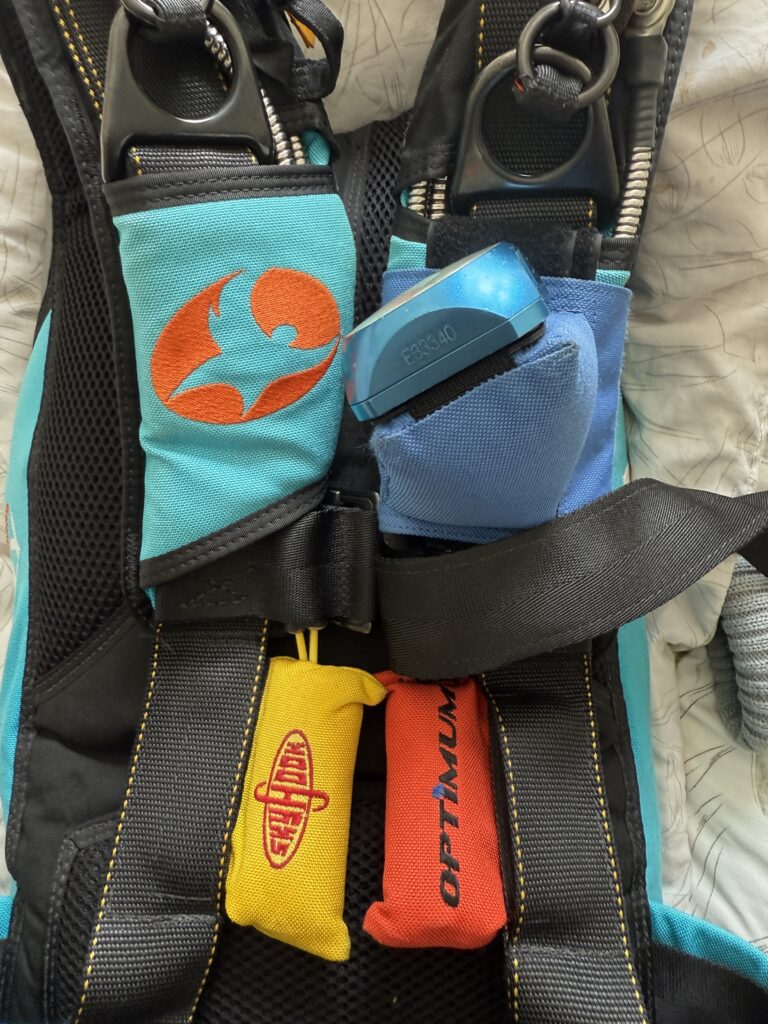
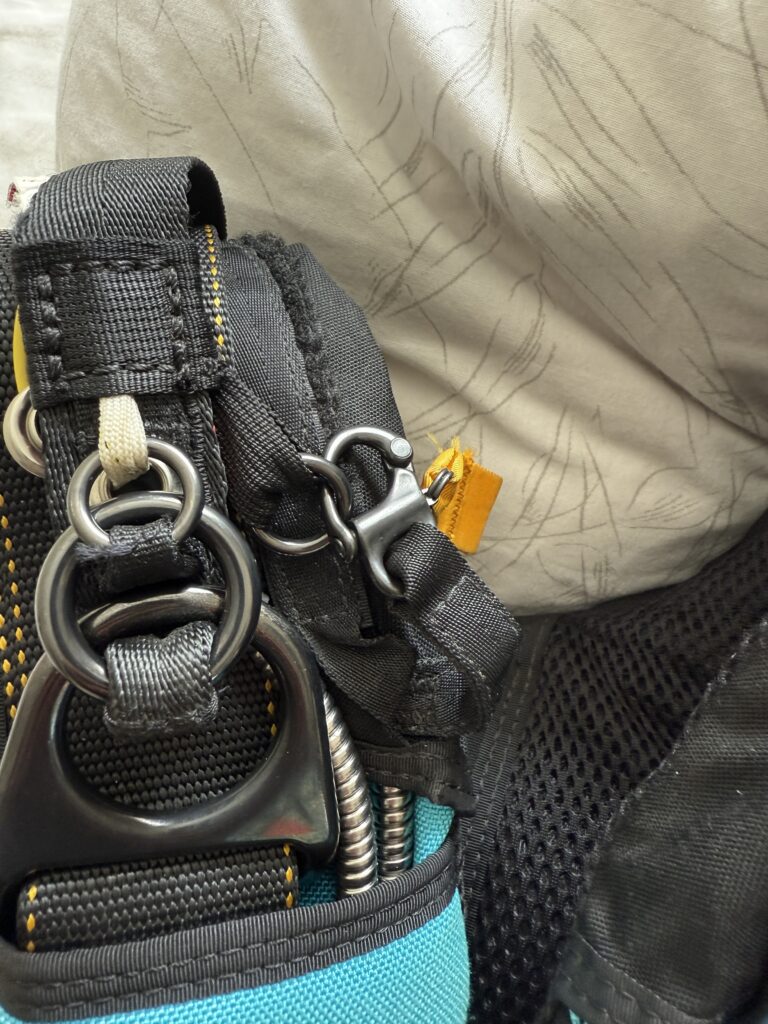
This has always been a debate in wingsuit circles – do systems that reduce the time from cutting your main canopy away to a reserve canopy being inflated cause more problems than solve? On initial inspection why would you not use things like Skyhook or an RSL? They have been around for ages and proven to save lives.
Well the main concern centres on that of spins. A wingsuit can be prone to flat spins (if you allow them to get that far) and if you are unable to recover that spin back to stable flight then we tend to teach deploy your main as some kind of sacrificial drogue chute
Obviously the main concern is that the wingsuit spin will induce line twists which can tip the canopy over causing another (canopy) spin to start (hopefully slower) that may then need you to release your main and use your reserve.
This final action can then mean you are spinning under your main when you release it which means it’s more than likely that your reserve will end up in line twists that now need to be resolved (again while in a flying body bag and you are very, very dizzy).
This potential scenario has concerned enough people to not use Skyhook, MARDS and I know at least 1 person who does not even use an RSL, preferring instead to try and correct the spin manually before going for a reserve canopy.
Ok, here I am going to take the easy way out and not offer any advice – again we are at the sharp end of skydiving and getting to this point means you already have a level of experience and judgement under your belt to make the right decision for you.
I will tell you my decision – I use a Skyhook AND an RSL, my thinking is that if things have gone THAT wrong I want some kind of material over my head as quickly as possible.
Given the speed at which Skyhooks work I judge there will NOT be sufficient time for enough twists to build for this to be a big enough problem (and at that stage I have enough of those).
Consider the alternative – you have had a very violent flat spin, you are incredibly dizzy and all the nausea associated with it. You have now pulled your main which was also very violent and now spinning in a totally different orientation compounding your issues. Are you going to be of clear enough head to work out which way you are spinning under your main to resolve this in time (time is ticking and that ground is closing in)?
As with such important safety aspects, do speak with instructors and coaches, get all the facts and make a judgement call that works for you. In general I would recommend but not mandate RSL/ Skyhook use and you simply do not have to have either to make a start.
Bottomless Corners
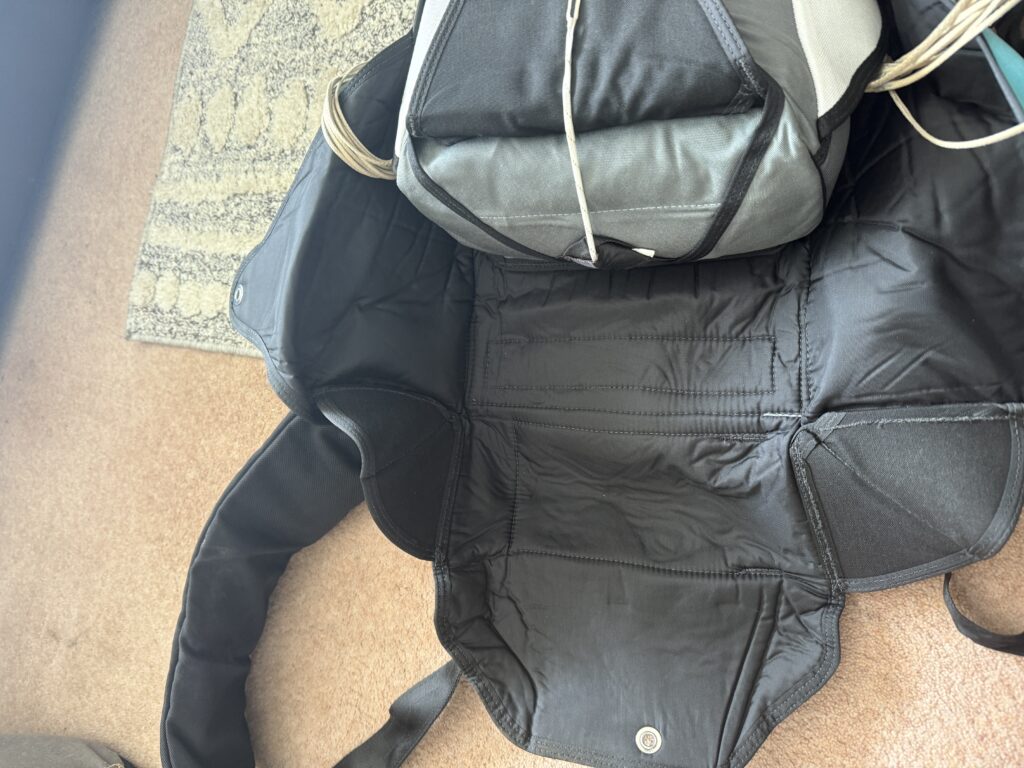
Lots of skydivers who spend more of their jumps flying wingsuits or fly high performance canopies for swoop competitions tend to have containers with bottomless corners.
The idea being that during the deployment sequence the bottom tray will open out flat and allow the deployment bag to leave the container without contacting any of the closing flaps and imparting a rotation that may result in line twists and complications further along the deployment sequence.
This can be helpful when flying wingsuits as our increased forward speed means the deployment bag comes off more at an angle towards our feet rather than traditional straight up deployments that most slick jumpers enjoy.
The trade off with these cleaner deployments is that our packing routine becomes harder since we have less of a container tray to guide us when packing (I would certainly not recommend bottomless corners to new jumpers) and I for one do not enjoy packing my bottomless container and ensuring the bridle is hidden, bottomless corners makes that more of a challenge.
Equally bottomless corners does not in any way guarantee that line twists are a thing of the past, they will still happen from time to time – all we are doing here is reducing the risk / frequency rather than preventing them entirely.In general you do not need bottomless corners to fly a wingsuit, and I know several pilots that fly some super big and very fast suits that simply have standard corners on their containers. It’s an option you can configure for later on but if you don’t have these then don’t worry (I certainly wish I had not optioned them – but each to their own).
Conclusions
My hope is that the above shows that for your first forays into Wingsuiting you DO NOT need ultra specialised kit to have a go.
In general to get started and with small wingsuits then
- You do not need a special container – just one that is free fly friendly
- You do not need a special Pilot chute – just one in good condition that works
- You do not need a longer bridle
- You do not need a special deployment bag
- You do not need a massive tank of a canopy – just a sensible one
- You do not need a special AAD – a standard one works just fine
- You do not need Skyhook / MARD
- You do not need bottomless corners – they are VERY annoying.
My first wingsuit jump (made in Z-Hills Florida 2011) was on an old icon I5 from 2004. It had a Pulse 150 (Semi elliptical 9 cell) canopy, No Skyhook, No extended bridle or wingsuit specific pilot chute and No bottomless corners. It had an Expert Cypres, no talking audible and for many of these early jumps I had a wrist mounted altimeter.
That setup (a far cry from what I have now) lasted me hundreds of wingsuit jumps and while I certainly had a few silly adventures with it, the actual setup was perfectly fine and never represented a risk to me flying a wingsuit.
Hopefully this has helped and given you a much better sense of that you need to get started – as always we, your UK Wingsuit Coaches, are here to help so please feel free to reach out to us at https://staging.wingsuiting.uk/coaches/